
Background
World Population Day, which seeks to focus attention on the urgency and importance of population issues, was established by the then-Governing Council of the United Nations Development Programme in 1989, an outgrowth of the interest generated by the Day of Five Billion, which was observed on 11 July 1987.
By resolution 45/216 of December 1990, the United Nations General Assembly decided to continue observing World Population Day to enhance awareness of population issues, including their relations to the environment and development.
The Day was first marked on 11 July 1990 in more than 90 countries. Since then, a number of a number of UNFPA country offices and other organizations and institutions commemorate World Population Day, in partnership with governments and civil society.
The UN and Population
The UN Population Division collaborates closely with the agencies, funds, programmes and bodies of the United Nations system in the implementation of the work programme on population and in the follow-up to the International Conference on Population and Development. United Nations missions, national Government offices, United Nations offices, researchers, media representatives and the public regularly consult the Population Division regarding population estimates and projections, and information and analyses on population and development issues.
Source: Text & Image: https://www.un.org/en/observances/world-population-day/background
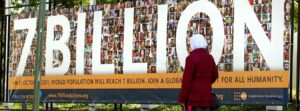
Picture: The world’s population reached 7 billion on 31 October, 2011. Pictured near an entrance to UN Headquarters is a banner for a global campaign by UNFPAto build awareness of the opportunities and challenges posed by this milestone. UN Photo/Rick Bajornas
The theme for World Population Day this year is “Realizing the hopes and aspirations of young people – today and for the future.”
The theme reflects a new report on the findings of the UNFPA Demographic Futures Survey, which asked more than 100,000 Internet-connected people aged 18 to 39 in 73 countries about their partnership, reproductive and life aspirations.
Source: Text: https://www.unfpa.org/events/world-population-day