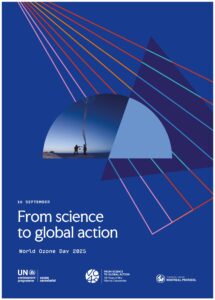
2025 Theme: From science to global action
Forty years ago, nations came together under the Vienna Convention for the Protection of the Ozone Layer and agreed to take appropriate measures to protect people and the planet from harmful UV radiation pouring through a potentially damaged ozone layer.
They succeeded. Based on additional scientific information, the Montreal Protocol was adopted and chlorofluorocarbons – man-made chemicals used in refrigeration, aerosol sprays and foam production – started being phased out setting the ozone layer on the road to recovery.
This year, on the International Day for the Preservation of the Ozone Layer, we celebrate this historic achievement and look forward to another forty years of action. The Montreal Protocol and Vienna Convention remain crucial for monitoring ozone and UV radiation levels, as well as ozone-depleting substances and other chemicals, such as hydrofluorocarbons (greenhouse gases), being phased out under the Kigali Amendment.
The ozone treaties have epitomized the concept of moving from Science to Global Action. And they will do so for many years to come.
Background
A number of commonly used chemicals have been found to be extremely damaging to the ozone layer. Halocarbons are chemicals in which one or more carbon atoms are linked to one or more halogen atoms (fluorine, chlorine, bromine or iodine). Halocarbons containing bromine usually have much higher ozone-depleting potential (ODP) than those containing chlorine. The man-made chemicals that have provided most of the chlorine and bromine for ozone depletion are methyl bromide, methyl chloroform, carbon tetrachloride and families of chemicals known as halons, chlorofluorocarbons (CFCs) and hydrochlorofluorocarbons (HCFCs).
Vienna Convention for the Protection of the Ozone Layer
The scientific confirmation of the depletion of the ozone layer prompted the international community to establish a mechanism for cooperation to take action to protect the ozone layer. This was formalized in the Vienna Convention for the Protection of the Ozone Layer, which was adopted and signed by 28 countries, on 22 March 1985. In September 1987, this led to the drafting of The Montreal Protocol on Substances that Deplete the Ozone Layer.
Montreal Protocol
The principal aim of the Montreal Protocol is to protect the ozone layer by taking measures to control total global production and consumption of substances that deplete it, with the ultimate objective of their elimination on the basis of developments in scientific knowledge and technological information. It is structured around several groups of ozone-depleting substances. The groups of chemicals are classified according to the chemical family and are listed in annexes to the Montreal Protocol text. The Protocol requires the control of nearly 100 chemicals, in several categories. For each group or annex of chemicals, the Treaty sets out a timetable for the phase-out of production and consumption of those substances, with the aim of eventually eliminating them completely.
Universal ratification
On 16th September 2009, the Vienna Convention and the Montreal Protocol became the first treaties in the history of the United Nations to achieve universal ratification.
Kigali Amendment
The Parties to the Montreal Protocol on Substances that Deplete the Ozone Layer reached agreement at their 28th Meeting of the Parties on 15 October 2016 in Kigali, Rwanda to phase-down hydrofluorocarbons (HFCs).