Week after week, the Sunday celebration offers us texts from Scripture to inspire our prayer.
A reading from the Old Testament, one from the New Testament, and a section of one of the four gospels.
There is an additional text – it is that of a Psalm used as a response to the 1st reading.
The Psalms can be seen as hymns, or liturgical songs.
They are voiced, or sung, as praises and thanks to God.
These texts focus on God himself, on his qualities.
Usually, they also outline what God has done for human beings.
 Many of the Psalms are attributed to David, the great king and musician.
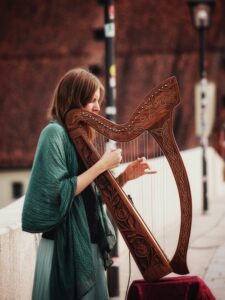
Many other authors have used this style of liturgical prayer often using musical instruments like the harp.
Personally, I have discovered another aspect of these prayers.
I see them as… a proclamation of faith, something that could be compared to…
the Creed that we recite every week.
The author lists what he has witnessed, what he has experienced of God.
This type of profession of faith is altogether revealing and inspiring!
Today’s celebration is a good illustration of this:
“The word of the Lord is integrity itself
all he does he done faithfully;
he loves virtue and justice,
the love of the Lord fills the earth.
The eyes of the Lord is on those who fear him, *
on those who rely on his love,
to rescue their souls from death
and keep them alive in famine.
Our soul awaits the Lord, he is our help and shield” (Psalm 33:4-5.18-20).
This short extract draws our attention and invites our praise for:
God’s integrity, his faithfulness, his justice, his love, his care, his help, his protection.
 There is another aspect of the Psalms not mentioned yet:
they can be, and they often are, a meaningful prayer that requests something from God!
The last verse of today’s section of the Psalm is precisely this type of prayer as it asks:
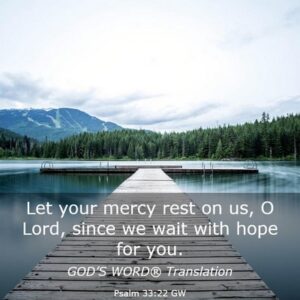
“Lord, let your love rest on us as our hope has rested in you” (Psalm 33:22).
As we progress in this Lenten period, would it not be a prayerful exercise to…
write a Psalm – one that is a personalised text of what we have experienced of God in our own lives?
It could become some kind of revelation… even to ourselves!
Note: In a few words, it should be mentioned that the “fear of the Lord” must be understood as the special respect that we have in his presence, and the particular desire of not being unfaithful to the God who loves us and cares for us. It is NOT the anxiety felt in front of a powerful ruler, nor the worry of someone guilty fearing a punishment.
Note: Another reflection is available on a different theme in French at: https://image-i-nations.com/2e-dimanche-du-careme-annee-a-2026/
Source: Images: unsplash.com (Chi Nguyen Phung)
https://www.scripture-images.com/bible-verse/gw/psalms-33-22-gw.php